
BLOG

A Biophysical Journal article analyzing the light-momentum-change method (IMPETUX technology) has been published

A Biophysical Journal article analyzing the light-momentum-change method (IMPETUX technology) has been published

2c5768_f5f3f9affcf24d32ae663ef0064c3d35.jpg_srb_p_166_135_75_22_0.50_1.20_0The authors present a comparison between two different methods for measuring forces inside living cells and provide measurements of the stall force of kinesin in vivo using the momentum-based approach.

[button link=”http://www.cell.com/biophysj/abstract/S0006-3495%2814%2900752-8″ color=”red” newwindow=”yes”] Read More[/button]
More news:

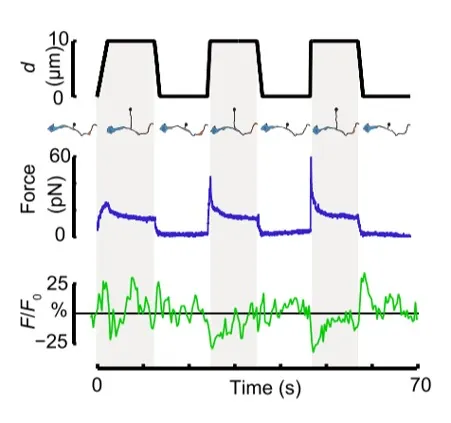
Fig. 1

Time dependence of trap position (top), force signal (middle) and Ca2+ fluorescence signal (bottom) recorded during a membrane tether pulling experiment. The force and Ca2+ ion channel activity signals exhibit negative correlation.

Fig. 2

Force and displacement data for two beads stimulated at frequencies of 4 Hz and 0.25 Hz. The progressive reduction of the beads displacement is in concomitancy with an increase of the applied force and loading rate.

Fig. 1

Schematic representation of the optical tweezers experiment. A fibronectin-coated bead is trapped, brought into contact with the cell membrane and stimulated with oscillations at different frequencies.

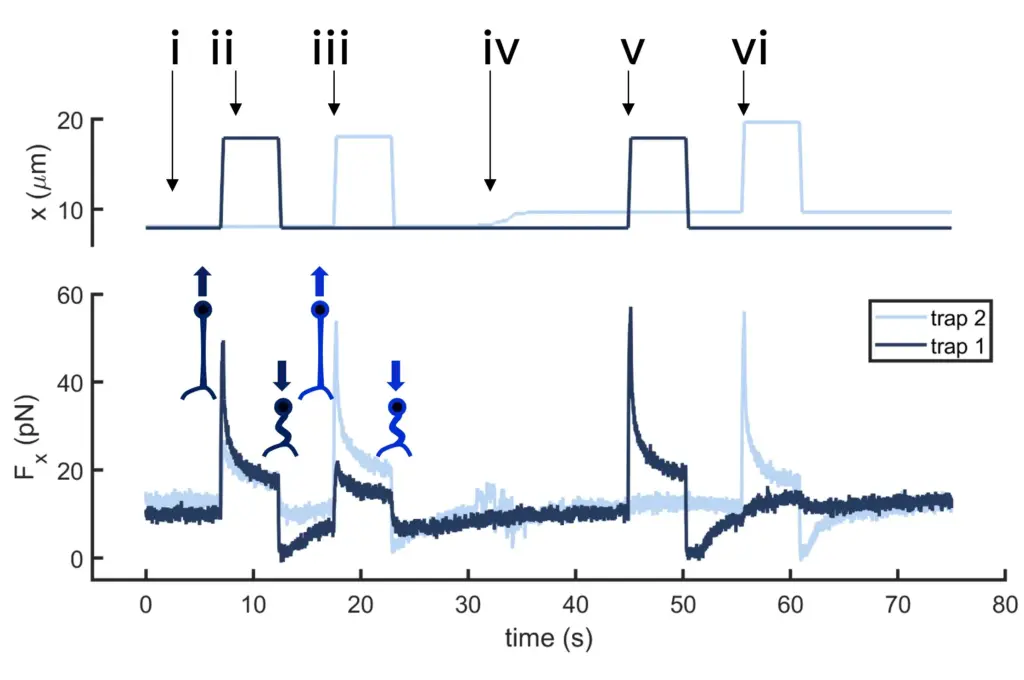
Fig.2

Time dependence of trap 1 and trap 2 position (top) and force (bottom) data along the different steps of the described dual tether pulling experiment.

Fig.1

Confocal video of the described dual tether pulling assay performed on a neuron axon. Courtesy of M. Krieg lab (ICFO).

Fig. 1

Time dependence of trap position (top), force signal (middle) and Ca2+ fluorescence signal (bottom) recorded during a membrane tether pulling experiment. The force and Ca2+ ion channel activity signals exhibit negative correlation.

Video 1

Confocal video showing a DVA neuron Ca2+ ion channel activity in a dynamic optical trapping assay. The pulling rate applied to the membrane tether is progressively increased. Scale bar = 5µm. Acquired at 10Hz.