Two scientific articles form the 15th Workshop on Information Optics (WIO) (2016), have been released:
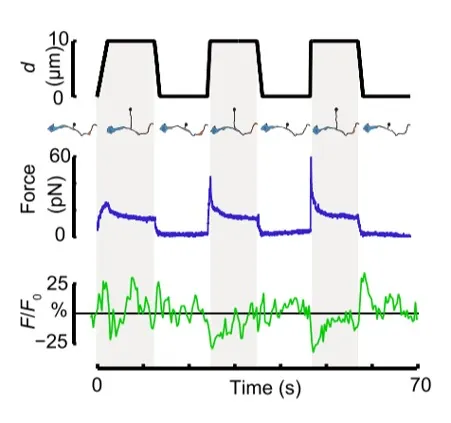
Optical tweezers for force measurements and rheological studies on biological samples
and
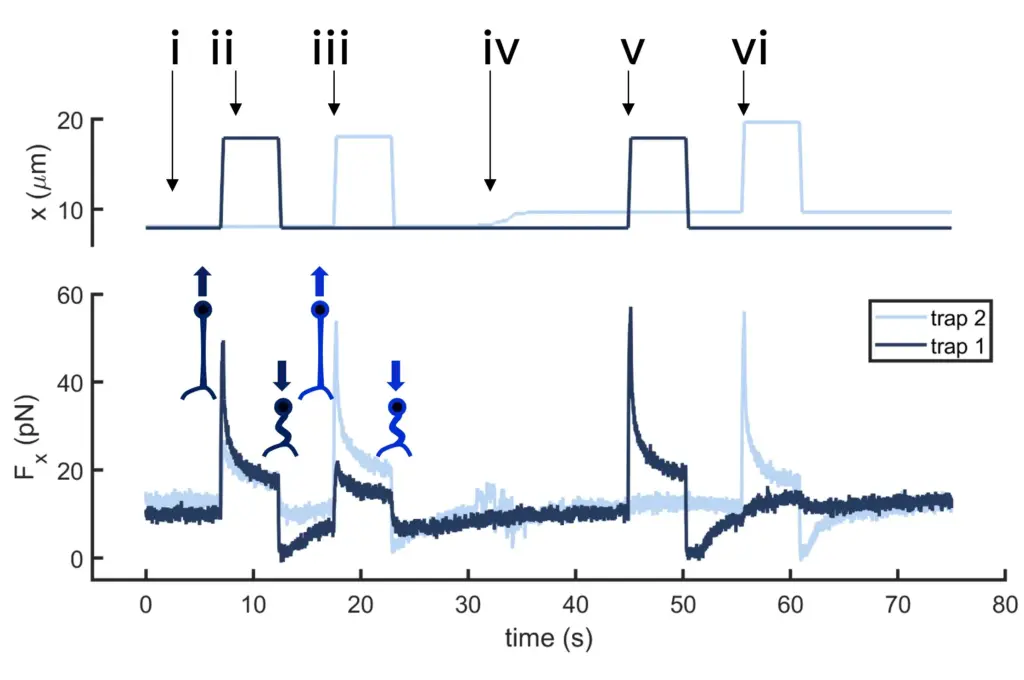
Force measurement in the manipulation of complex samples with holographic optical tweezers
Both are related with the IMPETUX technology and good examples of its applications.
We invite you to have a look!
Optical tweezers for force measurements and rheological studies on biological samples
R. Bola, F. Català. M. Montes-Usategui, E. Martín-Badosa
 Abstract: Light allows the observation of the microscopic world but also, by means of optical tweezers, the non-invasive manipulation of micro-objects and the measurement of the forces exerted on them. However, measuring forces inside living cells is still a challenge due the characteristics of the trapped organelles (non-spherical, unknown size and index of refraction) and the cell cytoplasm surrounding them (heterogeneous and dynamic, non-purely viscous). Here, we show how two very recent methods overcome these limitations: on the one hand, forces can be measured in such environment by the direct detection of changes in the light momentum; on the other hand, an active-passive calibration technique provides both the stiffness of the optical trap as well as the local viscoelastic properties of the cell cytoplasm.
You will find the complete article here.
Force measurement in the manipulation of complex samples with holographic optical tweezers
Martín-Badosa, F. Català, J. Mas, M. Montes-Usategui,A. Farré, F. Marsà
 Abstract: Holographic optical tweezers are a powerful tool for the dynamic manipulation of micron-sized objects with light. The measurement of the forces exerted by the traps by direct detection of beam momentum is not restricted to spherical samples, viscous environments or the assumption of a harmonic trapping potential. Here, we demonstrate that forces on complex beams, such as a multiple trap system or a cogwheel beam, or samples such as cylinders, can be measured with this method. It also allows quantitative studies inside the cell, where molecular motors exert characteristic forces within a heterogeneous and viscoelastic medium such as the cytoplasm.
You will find the complete article here.