BLOG

The Nobel Prize

The Nobel Prize

The Nobel Prize in Physics 2018 has recognized the great pioneering work in the field of laser done by Arthur Ashkin, Gérard Mourou and Donna Strickland. Congratulations to the three of them for this well deserved recognition and especially to Dona Strickland for becoming only the third woman in history to win the physics prize. Her predecessor: Maria Goeppert-Mayer was awarded 55 years ago!

We are also especially happy for the Arthur Ashkin work recognition related with optical tweezers and their application to biological systems. It has been an inspiration for us. This acknowledgment represents an additional motivation to continue working on bringing the optical tweezers technology to the mainstream market of biomedical scientific instrumentation. The already proved potential of the technology and the research advances already done using them are extremely promising.

The Nobel Prize in Physics 2018. NobelPrize.org. Nobel Media AB 2018. Mon. 22 Oct 2018.

You will find more details about the prize here.
 

More news:

Fig. 1

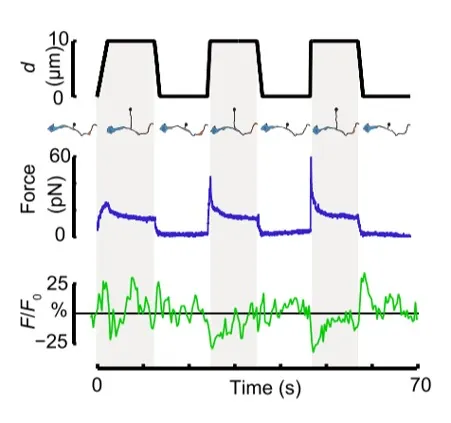
Time dependence of trap position (top), force signal (middle) and Ca2+ fluorescence signal (bottom) recorded during a membrane tether pulling experiment. The force and Ca2+ ion channel activity signals exhibit negative correlation.

Fig. 2

Force and displacement data for two beads stimulated at frequencies of 4 Hz and 0.25 Hz. The progressive reduction of the beads displacement is in concomitancy with an increase of the applied force and loading rate.

Fig. 1

Schematic representation of the optical tweezers experiment. A fibronectin-coated bead is trapped, brought into contact with the cell membrane and stimulated with oscillations at different frequencies.

Fig.2

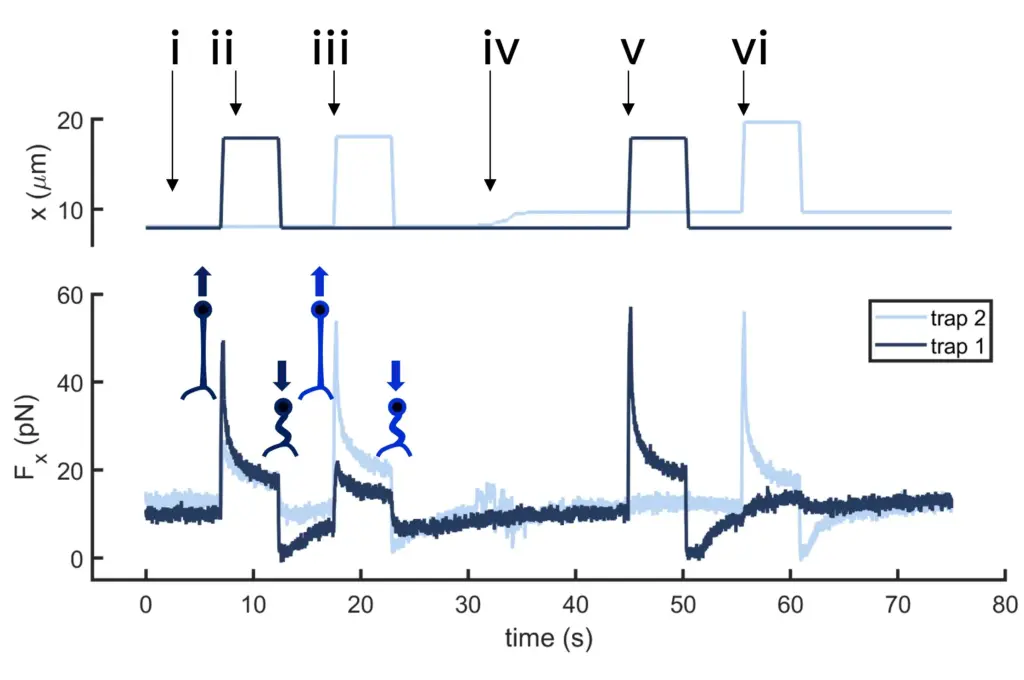
Time dependence of trap 1 and trap 2 position (top) and force (bottom) data along the different steps of the described dual tether pulling experiment.

Fig.1

Confocal video of the described dual tether pulling assay performed on a neuron axon. Courtesy of M. Krieg lab (ICFO).

Fig. 1

Time dependence of trap position (top), force signal (middle) and Ca2+ fluorescence signal (bottom) recorded during a membrane tether pulling experiment. The force and Ca2+ ion channel activity signals exhibit negative correlation.

Video 1

Confocal video showing a DVA neuron Ca2+ ion channel activity in a dynamic optical trapping assay. The pulling rate applied to the membrane tether is progressively increased. Scale bar = 5µm. Acquired at 10Hz.